Wednesday, February 21, 2024

Preface and Introduction by troublemakers

Connections: 

In the beginning of the "Introduction" paper. It talks about this sense of "power," "I had power over him, and his success relied on his ability and willingness to accept that." I really focused on this quote because it can relate to one of my campers I had this summer. With counseling a summer camp, comes with a lot of crazy and uncontrollable kids. I had this one kid named Ethan and he was about to get kicked out of camp for his outgoing behaviors. The director gave him one more change to stay in the camp but he had to succeed. I personally used my power to help this kid succeed. I focused more on him and what he was doing throughout the day so it was tough for him to get in trouble. The director put it in my hands because I had power over Ethan. It reminds me of Anthony in this text and how they refer to him. It gave this poor teacher nightmares and made her day a lot longer than it had to be. 

Also in the second "preface" section, the author highlights as a human being school isn't the only place people must be treated free but it should also be a place to learn. In classrooms you should be able to practice and experience freedom. Here I can also connect this to my summer camp because beginning the year my director that guided us counselors all day gave us a meeting. And the one thing I remember very vividly was the fact he kept repeating freedom and fun. Yes, we had to control these kids but it is also their summer and he wanted them to have the most fun possible. Give their freedom until they broke it, let them have fun with their friends, let them come and go as they please, or even let them decide if they want to play or not. 


Reflections: 

A lot of this text I could connect with my job this summer counseling. The idea of freedom and students not following their instructors can all relate to how this summer went. I had students like Anthony who didn't listen to me all summer until I had to send him to the director which was almost considered the principal. Then I had other campers where I could let them come and go as they please and never had to worry about them because of the way they acted. As an example, going to the bathroom, I let some campers just go with no reaction, but others I had to know when and where they were going, and make sure they came back in time. Kids start to think of themselves as troublemakers and they just automatically get treated that way and they clearly show that's the way they feel. 

https://www.jotform.com/blog/behavior-modification-at-summer-camps/#:~:text=Setting%20behavior%20guidelines,than%20they%20do%20at%20home.

Teaching Kids to Think Before They Speak | YourCareEverywhere

Sunday, February 11, 2024

The Academic and Social Values of Ethnic Studies

 Overview/Reflection: In the reading we learned that ethnic studies are very important because of the end result. They want students to be completely balanced with what they are learning. The author highlights the fact that throughout schooling, we create this sense of connection between who we are learning about and ourselves. We put ourselves in their shoes so we can feel how they really felt during that moment and time period we are currently learning about. 

This example, can also connect us to the "Precious Knowledge" video previously watched in class. In that video they are protesting. A high school in Arizona,  shows us how important learning about their own Mexican societies background is to them. They want everyone to learn about what they went through. The only way in their eyes to get this point around is to protest through the school system. In this specific video, what it presents is the feeling of latino students when topics that are related to their cultural background are presented. Shown in this text, it talks about what we students currently learn, where we can compare this to the video where they learn about their own backgrounds. Both mention the feeling of being judged, how big it is so students. Therefore, to come to conclusion in the reading ("The academic and social values of ethnic studies") students feel more involved in their learning when it is about their own social background. Christine emphasizes this heavily, she just reemphasizes this fact that students are way more engaged when they're learning about themselves. In the Documentary, they demonstrate what they are learning throughout everyone participating over and over in the classroom. This also built an extreme environment in Arizona having a bunch of students rally together to fight for something they believed in. 


Site:https://www.ascd.org/el/articles/respect-in-the-classroom-reflections-of-a-mexican-american-educatorInvisible' Children: Raised In The U.S., Now Struggling In Mexico : NPR Ed  : NPR

Sunday, February 4, 2024

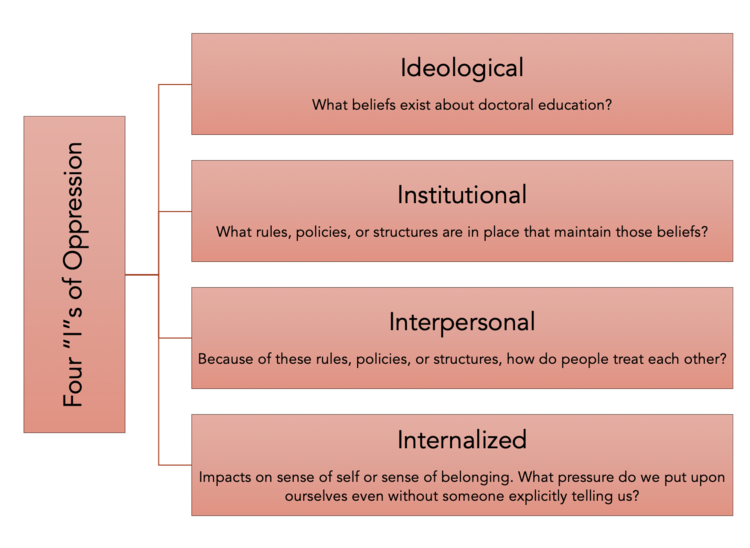
The Four I's of Opression

 The Four I's of oppression (Ideological, Internalized, Interpersonal, and Institutionalized) explains how oppression is apart of our everyday lives. It always shows up in everything we do but it is never really taken into consideration. It is more important than we even realize, the importance is never really reflected on. The Four I'd for a teacher specifically is one of the most important things to take note on when learning furthermore about students and how to keep everyone in your classroom in check. 


(Video)"Consider stereotypes you've heard for a boy crying for instance, you never think of this. It's always a girl crying" 

This shapes the way we look at different things. This falls under the Ideological category. It is the most important because it is the root of all categories. You can also think about it like girls are supposed to be pretty while men are handsome. I just used that example because it was the first one. 

"Internalized oppression can have severe impacts, such as feelings of despair, anxiety, depression, fatalism, self-hatred and even suicide." (pg2)

Here talking about internalization, we come to realize the impacts that could possibly occur. These are no joke clearly, they can stick with people. We get a sense of seriousness when looking at possible outcomes. 

An example of institutional oppression "The idea that laws are put into place in order for everyone to be able to work." 

We see this socially. through political issues. As an example of this we could also use the fact that some schools have more money funded than other schools. For instance South Kingston has way more funds than a small providence school. We saw this in the video and got a good understanding on why things are the way they are. Overall, it is just the mistreatment of people within the same social group supported by society. 

https://www.grcc.edu/sites/default/files/docs/diversity/the_four_is_of_oppression.pdf

Tuesday, January 30, 2024

The Silenced Dialogue

 Throughout this book written by Lisa Delpit, we start to make loads of connections with Alan Johnson. These stories are similar in some ways but different in others. They are both talking about privilege, power, and culture. They both have a sense of education society but do it in different ways. Delpits story is more surrounded by the fact non-white teachers are often found excluded. Delpits whole idea of this is to change students perspectives, she wants them to think in a positive way when it comes to the classroom. 

"Those with power are frequently less prepared." (pg24)

Throughout this quote, we can tell Delpit wants us not to hide what's going on. She makes a great point when saying those with more power seem to forget bout the bigger picture. They have everything in front of them they don't worry about anyone but themselves. They don't worry about what they say or do, they won't be hurt by it. 

Delpit mentions "Power of culture" many times. 

This forces a better understanding of education,  power repeating over and over again throughout this story. It gives us a good concept to the importance behind this. Changing everyones view on racism throughout schools would help not only the teachers but the students. 

Closing thoughts:

With the quotes presented in "The Silence Dialogue," we get a good understanding on the power through different cultures. In the United States, education has always been a state function, which means that it is not legal for the department of education to change the curriculum. For instance, in each state, each educator, would have to agree on what needs to be added or subtracted into the education system. Changing the curriculum would mean that teachers would have to make hard choices in order to go against their individual views. 


https://learn.cli.org/best-practices/classroom-culture-and-environment/culture/


Sunday, January 28, 2024

Alan Johnson: Privilege, Power, and Difference

 In Alan Johnsons book, Privilege, Power, and Difference, something the author tries to lock into the readers head is that we are part of the problem. Society is the way it is these days because of the people in it. People don't realize that they are part of the problem. Johnson, in this book, emphasizes that they are the problem treating people unfairly. With everyone knowing that they are part of the unfair treatment, it makes it a lot easier to get a solution. 

Chapter 1: 

"If I succeed at that, then the meaning and emotional weight of concepts like "privilege" and "white racism" will soften and shift." 

I found this quote one of the most important in chapter 1 because before proposing this quote, he talked about what whites often experience when they come across some language. Then continues to follow up with this quote which is most important because it is what he wants us (the reader) to get out of this chapter. He tells us that language is very off-putting to some readers, he then goes on to say that certain words hold so much power, so they can't be used with the feelings put towards them. 

Chapter 2: 

"Its not that I have done something or thought bad or harbored bad ill will toward her because she's black and female. No, the problem is that in this world as it is, huge issues involving race and gender shape her life and mine in dramatically different ways." 

This was when he had a meeting with a female African American. I found this most important in this chapter because we have multiple views now. He started off by talking about the advantages he had because he was white. He then goes on to talk about the things he never has to worry about because of his gender, whereas she has to always be worried because she's a female and anything could happen to her at any time. 

Chapter 3: 

"There is nothing inherently frightening about what we don't know. If we feel afraid, it isn't what we don't know, that frightens us, it is what we think we do know." 

Chapter 3 talks a lot about what we don't know. It starts to make me question myself and what I actually do or don't know. The whole point about something being unknown is the fact it's all a big question. You never really know who or what is going to happen. Which is why the unknown have to make conclusions. 


Reflections: 

Its really nice to read about other peoples opinions on privilege. Personally, it helped me realize that there are people out there that don't make assumptions. I really enjoyed reading all three chapters of this book. 


Wednesday, January 17, 2024

About me

Art Solomon pitches Providence MLB Draft League ballpark - Ballpark Digest

Baseball is one of my main hobbies. I play for the school and have been playing for a while now. I also love hanging out with my brothers and just mainly being outdoors. I have 4 of them, so sadly for my mom, it is a lot of craziness. 

When you look at everything we have done this semester, what stands out to you as meaningful?

 Overview: When thinking back on the semester and everything Ive learned, I realize teaching is way more than sitting at a desk. Ive learned...