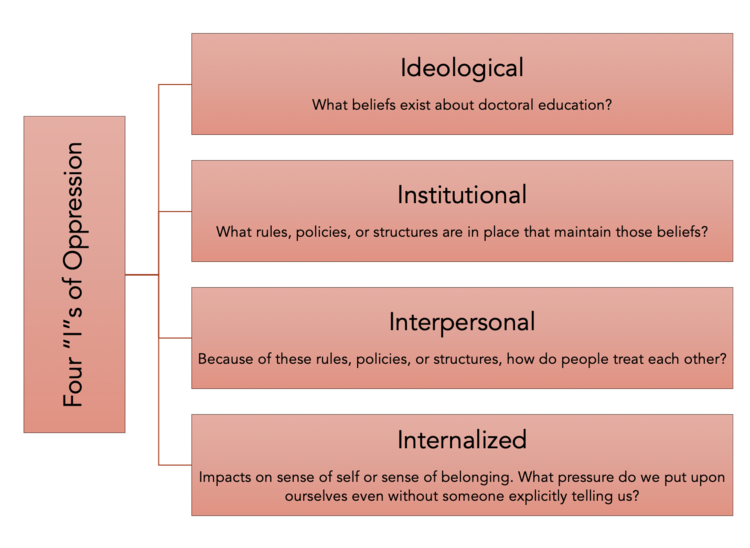
The Four I's of oppression (Ideological, Internalized, Interpersonal, and Institutionalized) explains how oppression is apart of our everyday lives. It always shows up in everything we do but it is never really taken into consideration. It is more important than we even realize, the importance is never really reflected on. The Four I'd for a teacher specifically is one of the most important things to take note on when learning furthermore about students and how to keep everyone in your classroom in check.
(Video)"Consider stereotypes you've heard for a boy crying for instance, you never think of this. It's always a girl crying"
This shapes the way we look at different things. This falls under the Ideological category. It is the most important because it is the root of all categories. You can also think about it like girls are supposed to be pretty while men are handsome. I just used that example because it was the first one.
"Internalized oppression can have severe impacts, such as feelings of despair, anxiety, depression, fatalism, self-hatred and even suicide." (pg2)
Here talking about internalization, we come to realize the impacts that could possibly occur. These are no joke clearly, they can stick with people. We get a sense of seriousness when looking at possible outcomes.
An example of institutional oppression "The idea that laws are put into place in order for everyone to be able to work."
We see this socially. through political issues. As an example of this we could also use the fact that some schools have more money funded than other schools. For instance South Kingston has way more funds than a small providence school. We saw this in the video and got a good understanding on why things are the way they are. Overall, it is just the mistreatment of people within the same social group supported by society.
 https://www.grcc.edu/sites/default/files/docs/diversity/the_four_is_of_oppression.pdf


No comments:
Post a Comment